
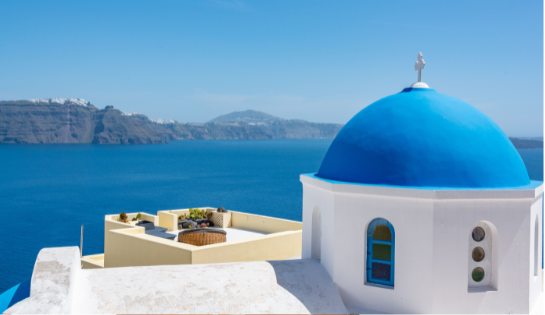
But long before it became one of the world’s most popular travel destinations, the island played a remarkable role in the history of the ancient Aegean. Known in antiquity as Thera, Santorini was an important cultural, commercial and maritime centre whose influence extended far beyond the Cyclades.
The island’s earliest flourishing civilization dates back to the Bronze Age, when the settlement of Akrotiri became one of the most advanced urban centres in the Mediterranean. Excavations have revealed sophisticated multi-storey buildings, elaborate drainage systems, paved streets and vibrant frescoes that demonstrate an exceptionally high standard of living. The discovery of imported goods from Crete, Cyprus, Egypt and the Near East confirms that Santorini was an important trading hub connecting different civilizations across the eastern Mediterranean.
One of the most significant events in the island’s history was the Minoan eruption, believed to have occurred around the 16th century BC. This massive volcanic eruption is considered one of the largest in recorded human history. It dramatically reshaped the island, creating the spectacular caldera that defines Santorini today. The eruption buried Akrotiri beneath layers of volcanic ash, remarkably preserving homes, artwork and everyday objects, much like Pompeii centuries later. Although historians continue to debate the wider consequences of the eruption, many believe it contributed to the decline of the Minoan civilization on Crete and inspired legendary stories such as Plato’s tale of Atlantis.
Following the volcanic catastrophe, the island was gradually resettled and later became known as Thera. During the early first millennium BC, Dorian settlers established a prosperous city on Mesa Vouno, overlooking the Aegean Sea. Ancient Thera developed into an important political and military centre, with temples, public buildings, marketplaces and residential districts reflecting its growing influence. The island also became famous for its strategic location along maritime routes connecting mainland Greece with Asia Minor and Egypt.
Santorini’s historical significance extends beyond trade and politics. Around 630 BC, settlers from Thera founded the colony of Cyrene in present-day Libya, one of the most successful Greek colonies of the ancient world. This expansion illustrates the island’s economic strength and maritime expertise during antiquity, as well as its contribution to the spread of Greek culture across the Mediterranean.
Today, visitors can explore this remarkable heritage through archaeological sites such as Akrotiri and Ancient Thera, where temples, inscriptions, streets and public buildings continue to tell the story of an island that helped shape ancient civilization. Museums throughout Santorini preserve extraordinary frescoes, ceramics and everyday artefacts that offer valuable insight into the lives of its earliest inhabitants.
Exploring these historic locations becomes much easier with a reliable Santorini car rental, allowing visitors to travel comfortably between archaeological sites, traditional villages and panoramic viewpoints while discovering the island beyond its famous caldera.
Santorini’s importance in antiquity lies not only in its extraordinary archaeological discoveries but also in its lasting influence on trade, colonization, art and mythology. From the thriving streets of Akrotiri to the ancient city of Thera, the island remains a living reminder of the civilizations that once flourished in the heart of the Aegean, making every visit a journey through thousands of years of history.